作者: <span>xiaohu</span>

Water droplets beading on a technical outerwear fabric, hydrophobic coating visible.
8 月 07, 2026

PFAS in Outdoor and Activewear: Where the 2026 Bans Actually Apply

JINJIANG, China \u2014 Per- and polyfluoroalkyl substances (PFAS) \u2014 the broad class of \u201cforever chemicals\u201d used in water-repellent finishes, stain-resistant coatings, and certain dye auxiliaries \u2014 are now subject to a patchwork of national and regional bans that materially affect outdoor and activewear supply chains. For garment exporters serving European, North American, and Australian markets, understanding where the bans actually apply \u2014 and where they don\u2019t \u2014 is essential for both product compliance and forward product planning. The current PFAS regulatory landscape in 2026 is best understood as a mosaic: federal and state-level rules in the US, EU-wide and member-state-level rules in Europe, and similar initiatives in Australia, Canada, and Japan. The rules vary by product category, by PFAS sub-class, by concentration threshold, and by date of entry into force. What\u2019s Actually Banned in 2026 EU-wide: The EU\u2019s REACH universal PFAS restriction proposal was submitted in 2023 and has been under review since. As of mid-2026, the EU has not adopted a universal PFAS restriction, but several PFAS sub-classes are restricted under existing REACH entries and under specific product regulations: PFOA and related compounds (since 2020) PFOS and related compounds (since 2009) C9\u2013C14 PFCAs and related compounds (since 2023) Specific PFAS used in textile finishing chemicals under the Detergents Regulation EU member-state level: Several EU member states have moved ahead of EU-wide restrictions: France: banned all PFAS in food contact materials, cosmetics, and ski wax (effective 2026); textile restrictions under review Germany: BfR-recommended restrictions on PFAS in textiles under the Chemicals Act amendment Denmark: national PFAS ban in consumer products, including textiles, effective 2026 United States: There is no federal PFAS ban, but state-level rules are increasingly consequential: New York: S4630A ban on PFAS in apparel (signed 2023, effective phased through 2026) California: AB 1817 ban on PFAS in apparel and textiles, effective 2025\u20132026 phased rollout Minnesota, Vermont, Washington: similar state-level restrictions, varying effective dates Australia: no federal PFAS ban, but state-level initiatives are advancing in line with the EU and US. The patchwork means that a single garment exported globally may need to comply with several different PFAS rules depending on destination. What\u2019s Not Banned (But Should Be Monitored) Several PFAS sub-classes remain in widespread use in outdoor and activewear as of mid-2026: Short-chain PFAS alternatives (e.g., C6 fluorotelomer-based DWR treatments) are not universally banned but face increasing restrictions under state-level rules and OEKO-TEX aggregate-PFAS limits PTFE-based membranes (used in waterproof breathable laminates) are PFAS but are typically exempt under current bans as \u201cessential use\u201d Specific PFAS used in printing inks and dye auxiliaries are restricted in some jurisdictions but not others For a factory running 30\u201350 outdoor and activewear styles, the practical 2026 question is not \u201care PFAS banned\u201d but \u201cwhich PFAS are restricted in which destination markets.\u201d Practical Compliance Steps for 2026 For garment exporters serving multi-destination outdoor and activewear markets: Map your DWR treatment chemistry by destination. Different destinations restrict different PFAS sub-classes. Your fabric mill\u2019s DWR stack may need to vary by destination. Verify your PFAS test reports against the most restrictive destination (typically California AB 1817 or New York S4630A). Meeting the strictest standard usually covers all other destinations. Identify non-PFAS DWR alternatives. C0 (fluorine-free) DWR treatments have matured significantly and are now widely used in mainstream mid-market outdoor wear. Performance is approaching conventional C6 DWR for most use cases. Check your lamination and membrane chemistry. PTFE-based membranes are typically exempt from current PFAS bans, but PU-based and TPU-based alternatives may be more restrictive in destination markets with broad PFAS rules. Document PFAS declarations per destination. Most major brands now require a destination-specific PFAS declaration as part of the technical pack. The Bottom Line PFAS in outdoor and activewear is regulated, not banned universally. The 2026 patchwork of federal, state, and member-state rules requires destination-specific compliance rather than a single global standard. Garment exporters that build PFAS compliance into their technical packs by destination, and that have validated non-PFAS DWR alternatives ready, will be in the strongest position as restrictions continue to tighten through 2026 and 2027.
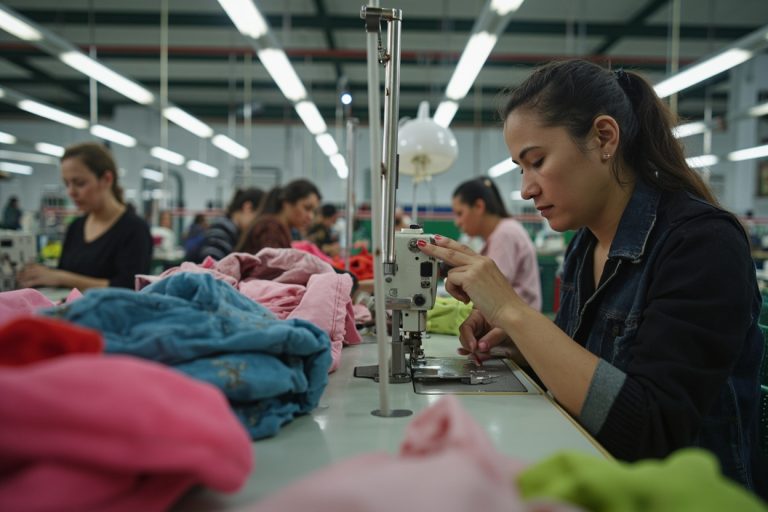

Garment factory production line with workers sewing outerwear, organized industrial setting.
8 月 07, 2026

Bangladesh vs Vietnam vs China: 2026 Manufacturing Cost Comparison for Mid-Market Brands

JINJIANG, China \u2014 Mid-market apparel brands sourcing across multiple Asian countries in 2026 face a more complicated cost comparison than at any time in the past decade. Labor cost convergence in Vietnam and Bangladesh, capacity additions in both countries, and continued cost discipline in China have narrowed the historical cost gap, while tariff exposure and lead-time considerations continue to favor different countries for different product categories. The conventional wisdom that China is 30\u201340 percent more expensive than Bangladesh for labor-intensive apparel no longer holds. As of mid-2026, the all-in cost gap between China and Bangladesh for a comparable mid-market woven shirt is closer to 12\u201318 percent, and the gap is even narrower for knit products where China\u2019s supply chain integration offsets its labor cost disadvantage. Where Each Country Leads China retains its cost leadership in: Complicated outerwear (puffer jackets, bonded shells, technical fleece) Heavy knits and sweater programs with high yarn complexity Complicated prints and embroideries requiring multi-process capacity Short-lead-time production (3\u20134 week fabric-to-finished-goods windows) Quality consistency at scale for premium mid-market and premium-private-label programs Vietnam has gained share in: Basic knitwear (tees, fleece hoodies, activewear) Simple woven bottoms and denim Programs with US tariff exposure Brands prioritizing supply chain diversification away from China Bangladesh remains competitive in: Basic knitwear at the lowest cost tier Large-volume basic woven bottoms (chinos, basic denim, basic shirts) Programs where lead time can be extended to 10\u201312 weeks Cotton-rich product categories Cost Components Comparison For a representative mid-market woven shirt in 2026: Direct labor: China $1.10\u2013$1.40, Vietnam $0.85\u2013$1.10, Bangladesh $0.65\u2013$0.85 Fabric: China $2.20\u2013$2.80, Vietnam $2.30\u2013$2.90, Bangladesh $2.40\u2013$3.00 Trims: China $0.40\u2013$0.55, Vietnam $0.45\u2013$0.60, Bangladesh $0.45\u2013$0.60 Overhead: China $0.85\u2013$1.10, Vietnam $0.75\u2013$0.95, Bangladesh $0.65\u2013$0.85 Total landed (FOB): China $4.55\u2013$5.85, Vietnam $4.35\u2013$5.55, Bangladesh $4.15\u2013$5.30 The total landed cost gap is now narrower than at any point in the past decade. Labor cost differentials have narrowed most sharply: Bangladeshi factory wages have risen by approximately 8 percent annually over the past five years, while Chinese factory wages have stabilized at the higher end of the historical range. Tariff and Trade Considerations For US-bound apparel, the tariff landscape materially affects the cost comparison: China-origin to the US: Section 301 tariffs remain in place, with most apparel categories in the 7.5\u201315 percent tariff band Vietnam-origin to the US: duty-free under most-favored-nation rates for in-quota categories Bangladesh-origin to the US: duty-free under most-favored-nation rates for in-quota categories For a US-bound woven shirt at $5 landed cost, the Section 301 differential alone is approximately $0.40\u20130.85 per shirt. This is a meaningful cost difference that has driven much of the mid-market diversification to Vietnam and Bangladesh over the past five years. For EU-bound apparel, all three origins face the same EU tariff regime (standard EU GSP rates), so the cost comparison is closer to a pure landed-cost comparison. Lead Time Considerations China retains a meaningful lead-time advantage for time-sensitive production: China fabric-to-finished-goods: 3\u20134 weeks for most knit and woven products Vietnam: 4\u20136 weeks Bangladesh: 6\u201310 weeks For brands with seasonal programming or fast-replenishment models, the Chinese lead-time advantage remains a meaningful offset to some cost differential. The Bottom Line for Q4 2026 The China-versus-rest-of-Asia cost gap is at its narrowest in a decade, but the relative competitiveness varies materially by product category. Complicated outerwear, technical knits, and short-lead-time production remain most cost-effective in China. Basic knitwear and woven bottoms at the lowest cost tier are increasingly competitive in Vietnam and Bangladesh, especially for US-bound product where Section 301 tariffs apply. The most successful mid-market brands in 2026 are running multi-country sourcing strategies that match product category to country cost structure, rather than defaulting to a single sourcing destination. For Chinese garment exporters serving this market, the implication is clear: the Chinese factory\u2019s competitive advantage is shifting from labor cost to supply chain integration, lead time, and complicated-product capability.

Textile testing laboratory scene with fabric samples and testing equipment.
8 月 07, 2026

OEKO-TEX Standard 100 Updates for 2026: New Restricted Substances and Test Methods

JINJIANG, China \u2014 OEKO-TEX released its annual Standard 100 update on January 2, 2026, with revised limit values for several substance classes that affect garment exporters serving European, North American, and Japanese buyers. The update is part of the standard\u2019s annual cycle and reflects new regulatory data from the European Chemicals Agency (ECHA), the US Consumer Product Safety Commission (CPSC), and Japan\u2019s Ministry of Health, Labour and Welfare. The 2026 update is more incremental than the 2024 update (which introduced major changes to PFAS testing methodology) and the 2025 update (which added new bisphenol restrictions). The changes for 2026 are focused on three areas: expanded PFAS sub-classes, refined heavy-metal migration limits, and new substance additions for emerging regulatory concerns. What\u2019s New for PFAS The PFAS class continues to be the highest-priority area for OEKO-TEX testing. For 2026, the Standard 100 expanded the PFAS test panel to include additional short-chain perfluorinated compounds and added a new aggregate-PFAS limit value measured by total organic fluorine (TOF) for Class I articles (babywear). In practical terms, this means that fabric mills and trims suppliers providing materials for OEKO-TEX-certified production must test a wider range of PFAS substances in their 2026 cycle. The aggregate limit is more stringent than any individual-substance limit, which means mills need to control total PFAS load in their finishing chemicals rather than relying on individual-substance compliance. Heavy Metal Migration Limits The 2026 update includes revised migration limits for several heavy metals in Class I and Class II articles, based on the latest ECHA opinions on bioaccessible metals. The practical effect is small \u2014 most compliant materials were already well below the new limits \u2014 but the documentation requirements have tightened. OEKO-TEX auditors will check that test reports specify the migration test method used and that the test lab is accredited to ISO 17025 for the relevant method. New Substance Additions The 2026 update added three new substances to the Standard 100 restricted substances list: D4, D5, D6 siloxanes \u2014 used in some textile softeners, with limit values aligned to the EU REACH restriction that entered into force in 2025 Specific UV stabilizers \u2014 benzotriazole derivatives used in some performance outerwear, with limit values based on recent ECHA opinions Selected aromatic amines \u2014 refinements to the existing azo-dye restriction based on new scientific data For most compliant mills, these additions are unlikely to require process changes. The limit values are set conservatively to allow for trace background levels, and the substances are not widely used in mainstream apparel finishing. Impact on Lead Times and Testing Costs The expanded PFAS panel and the new aggregate-PFAS limit will extend testing lead times by 1\u20132 weeks at most OEKO-TEX-accredited laboratories through the first half of 2026. As labs adjust capacity to the expanded panel, lead times should normalize by mid-year. Testing costs are expected to increase by approximately 15\u201325 percent per PFAS test report, reflecting the expanded panel. For a factory running 50\u2013100 OEKO-TEX tests per year, this translates to a manageable increase in the per-unit cost basis. Practical Steps for 2026 For garment exporters and fabric mills serving OEKO-TEX-certified production: Verify your OEKO-TEX-accredited lab\u2019s capacity for the expanded PFAS panel. Most major testing labs have already adjusted, but smaller or specialized labs may be slower. Update your RSL (Restricted Substance List) documentation to reflect the 2026 changes. Buyer RSLs typically cite the current OEKO-TEX Standard 100, so an outdated RSL will produce false-positive test results. Review your finishing chemicals inventory for D4/D5/D6 siloxanes, the specific UV stabilizers added for 2026, and any aromatic amines in your colorants. Communicate the changes to your buyers. The 2026 update affects all OEKO-TEX-certified production, so most EU and US buyers will want confirmation that your supply chain is current. The Bottom Line The 2026 OEKO-TEX Standard 100 update is an incremental rather than disruptive change. The expanded PFAS panel and the aggregate-PFAS limit are the most consequential changes; the heavy metal and substance additions are minor. Garment exporters with current OEKO-TEX certification should plan for slightly extended testing lead times and modestly higher testing costs in the first half of 2026, but should not expect significant process changes.

Stacked cotton bales and rolls of polyester filament yarn in a textile warehouse.
8 月 07, 2026

Cotton Futures and Polyester Filament Outlook: 2026 Price Drivers for Sourcing Teams

JINJIANG, China \u2014 Cotton and polyester filament together account for roughly 75 percent of the fiber volume used in mid-market apparel, and the price movements in both inputs over the past 18 months have shifted sourcing economics in ways that sourcing teams should plan around through the rest of 2026. The Cotton #2 futures contract closed the 2024/25 marketing year with a marked divergence between the New York and Zhengzhou contracts, reflecting different supply dynamics in the United States and China. New York cotton has traded in a relatively tight band through the first half of 2026, supported by a smaller US crop and steady export demand, while Chinese cotton on the ZCE has been more volatile on the back of state reserve rotations and shifting import flows from Brazil and Australia. For garment exporters, the practical implication is that cotton-heavy programs \u2014 typically 100 percent cotton jersey, brushed flannel, terry, and denim \u2014 face a more variable cost base than they did two years ago. The bench planning assumption that worked in 2023 (flat 12-month cotton pricing) is no longer reliable. Sourcing teams should expect 8\u201315 percent variation in landed cotton fabric costs over a six-month sourcing window, depending on which cotton futures month they lock against. Polyester Filament: More Volatile Than Cotton Polyester filament pricing has been the more dramatic story. Para-xylene (PX), the upstream feedstock for purified terephthalic acid (PTA), and PTA itself have all moved sharply over the past 12 months on the back of capacity additions in China and shifting crude oil benchmarks. The filament yarn price index most commonly used by mid-market apparel mills in China closed 2025 roughly 18 percent higher than the 2024 average, then softened in early 2026 as new PTA capacity came online. Spot prices for 75D/72F DTY (the most common polyester filament yarn used in knit outerwear and activewear) traded in a 25 percent range over the past 12 months \u2014 a degree of volatility that makes downstream polyester-blend fabric pricing significantly harder to lock. For sourcing teams, the practical implication is that polyester-heavy programs (most fleece, activewear, and bonded outerwear shells) are exposed to upstream feedstock volatility in a way that pure cotton programs historically were not. Cotton-Polyester Spread and Substitution Effects The relative price of cotton to polyester filament has narrowed considerably since 2024. As of mid-2026, the cotton-to-polyester price ratio sits close to its three-year average, after a brief period in late 2024 when cotton was unusually expensive relative to synthetics. The current spread suggests that the substitution pressure between cotton and polyester for mid-market apparel is roughly stable, with no strong near-term incentive for buyers to shift category blends in either direction. For sourcing teams running volume programs, this is a useful planning signal. The current pricing environment does not favor a wholesale shift from cotton to polyester (or vice versa) on cost grounds alone. Decisions should continue to be driven by end-use performance, brand positioning, and regulatory considerations (such as the recycled-content preferences of EU buyers). What Buyers Are Doing in 2026 Based on conversations with export-facing factories and intermediary agents, the most common 2026 buyer response to fiber price volatility has been to extend price-lock windows and to hedge fabric commitments through longer-term framework agreements. The traditional 30-day fabric price quote has largely disappeared for cotton-heavy and polyester-heavy programs. In its place: Quarterly price locks with explicit raw-material pass-through clauses 6-month framework agreements on core fabric references Forward orders on commodity fabrics placed 4\u20136 months ahead of need Hedging on the polyester side via PTA futures, available to larger mills and some larger garment factories Practical Implications for Sourcing Teams For a factory running 30\u201350 styles across cotton and polyester-blend fabrics, the practical 2026 playbook looks like this: Lock cotton-heavy styles early. Commit fabric 4\u20136 months ahead and lock against the front-month futures, not the cash market. Use quarterly price reviews on polyester blends. Polyester filament is too volatile to lock for longer than a quarter without an explicit pass-through clause. Track PTA capacity additions. New PTA capacity in China continues to add supply, which will pressure polyester filament prices through 2026. Watch the cotton reserve rotation. Chinese state cotton reserve sales continue to influence the Zhengzhou cotton price. Reserve sale schedules are published quarterly. Plan for a wider landed-cost band. Plan sourcing budgets against an 8\u201315 percent landed-cost band for cotton fabrics and a 15\u201325 percent band for polyester-blend fabrics. The Bottom Line for Q4 2026 Cotton and polyester filament pricing is more volatile than it has been in five years, and that volatility is unlikely to fully normalize through 2026. Sourcing teams that lock cotton-heavy programs early, hedge polyester exposure with quarterly reviews, and plan against wider landed-cost bands will be better positioned than those still operating on flat 12-month pricing assumptions.

Stacked shipping containers at a busy Asian port at golden hour, container cranes visible.
8 月 07, 2026

US Section 301 Tariff Review: Implications for Asian Apparel Sourcing Strategies

JINJIANG, China \u2014 The US Section 301 tariff regime on Chinese-origin imports has been in place since 2018, with various exclusions and adjustments over the years. The most recent tariff review process, completed in 2025, maintained the existing tariff structure for most apparel categories but introduced several changes that affect mid-market apparel sourcing strategies through 2026 and 2027. The current US tariff structure on Chinese-origin apparel as of mid-2026: Most apparel categories: 7.5\u201315 percent ad valorem Section 301 tariff Some categories (including certain cotton and synthetic fiber apparel): 25 percent Section 301 tariff A small number of strategic categories: exemptions restored under specific programs The tariff structure has been a major driver of mid-market sourcing diversification to Vietnam, Bangladesh, and other Asian countries over the past five years. The 2025 review did not reverse this trend, but it did introduce some refinements that affect specific product categories. What\u2019s New in 2026 The 2025 review concluded with several changes that affect apparel: Restored exclusions for certain medical and protective apparel. Some categories of medical-grade and protective apparel were excluded from Section 301 tariffs, recognizing their strategic importance. Adjusted tariff levels for some synthetic fiber apparel. Certain synthetic fiber categories that were previously at 25 percent were adjusted to 15 percent, narrowing the differential with cotton apparel. Continued exclusion process for specific HTS codes. The US Trade Representative continued the exclusion process for specific HTS codes, with quarterly reviews of pending exclusions. Strengthened rules of origin enforcement. The 2025 review also strengthened enforcement of US rules of origin, particularly for garments claiming Vietnamese or Bangladeshi origin when significant production occurred in China. Implications for Mid-Market Brands For a mid-market brand running a multi-country sourcing strategy, the 2026 tariff landscape affects sourcing decisions in three ways: Continued preference for Vietnam and Bangladesh for US-bound basic apparel. The Section 301 differential on basic knits and woven bottoms remains the dominant cost driver for US-bound sourcing. Continued Chinese competitiveness for complicated outerwear. For complicated outerwear and technical knits, the Chinese supply chain advantage often offsets the Section 301 tariff, particularly for shorter-lead-time and higher-quality programs. Increased scrutiny on origin claims. The strengthened rules of origin enforcement means that brands and sourcing agents need to verify the actual country of origin for garments claiming Vietnamese or Bangladeshi origin. This is particularly important for fabrics sourced from China and cut-and-sewn in Vietnam or Bangladesh. Enforcement Specifics for Apparel The strengthened rules of origin enforcement focuses on: Substantial transformation. US Customs applies the substantial transformation test to determine country of origin. For a garment to be considered Vietnamese or Bangladeshi in origin, the cut-and-sew assembly must occur in that country, and the garment must undergo a substantial transformation in that country. Fabric origin. For US preferential trade programs like the Generalized System of Preferences (GSP), fabric origin matters. For standard Section 301 calculations, the garment\u2019s country of origin (where the substantial transformation occurs) is what counts. Documentation requirements. Customs requires documentation of production processes, including cut-and-sew records, fabric sourcing records, and finishing records. Brands and sourcing agents should maintain these records for all production in Vietnam and Bangladesh. Practical Steps for 2026 For sourcing teams managing tariff exposure: Re-evaluate Section 301 cost impact annually. The 2025 review introduced changes; the 2026 or 2027 reviews may introduce more. Re-evaluate the cost impact on each program annually. Verify origin claims for Vietnam and Bangladesh production. Don\u2019t assume Vietnam or Bangladesh origin is automatic. Verify the cut-and-sew location and substantial transformation. Maintain documentation. Maintain cut-and-sew records, fabric sourcing records, and finishing records for all production. The documentation is essential for customs disputes. Consider the cumulative tariff impact. For some product categories, the cumulative tariff cost (Section 301 + standard US duties + antidumping) significantly affects the landed cost. Calculate the full landed cost for each sourcing destination. Watch for additional tariff changes. The 2026 US election cycle and changing trade policy priorities may introduce additional tariff changes. Monitor US Trade Representative announcements and respond quickly to changes. The Bottom Line The US Section 301 tariff regime on Chinese-origin apparel remains in place, with the 2025 review introducing targeted refinements but not broad changes. For mid-market brands, the tariff landscape reinforces the multi-country sourcing strategy that has been building since 2018: Vietnam and Bangladesh for US-bound basic apparel, China for complicated outerwear and shorter-lead-time production. The 2026 priority is to verify origin claims and maintain documentation in the face of strengthened customs enforcement.

Two children wearing colorful puffer jackets playing outdoors in autumn, family lifestyle.
8 月 07, 2026

CPSIA and EN 14682 Children’s Wear Compliance: 2026 Cross-Market Checklist

JINJIANG, China \u2014 Children\u2019s wear exporters face one of the most stringent compliance environments in the apparel industry, with the US Consumer Product Safety Improvement Act (CPSIA) and the European standard EN 14682 (cords and drawstrings on children\u2019s clothing) covering most of the safety requirements for garments sold to children under 14. The two regimes overlap in some areas and differ in others, and the practical 2026 compliance checklist for mid-market children\u2019s wear factories serving both markets includes several risk areas that have tightened in recent years. CPSIA Key Requirements The US CPSIA covers children\u2019s products up to age 12 and includes: Lead content limits: 100 ppm total lead content in accessible materials (substrate), with stricter limits for paint and surface coatings (90 ppm) Phthalate limits: Restrictions on eight phthalates in children\u2019s toys and child care articles, with some application to soft plastic components in children\u2019s wear Tracking labels: Required permanent tracking labels on children\u2019s products sold in the US, including manufacturer/producer information, date and place of production, and cohort information Small parts: Restrictions on small parts in children\u2019s products for children under 3, with specific testing requirements for toys and child care articles Flammability: Children\u2019s sleepwear must meet specific flammability standards (16 CFR 1615/1616) under the Flammable Fabrics Act For children\u2019s outerwear, the most relevant CPSIA requirements are lead content limits (especially for prints, coatings, and metal hardware), phthalate limits (for any plastic components), and tracking labels. EN 14682 Key Requirements The European standard EN 14682 covers cords and drawstrings on children\u2019s clothing up to age 14. The standard was tightened in 2025 with new requirements for hood toggles, elastic cords, and zipper pulls. Key requirements include: No drawstrings in the head and neck area for children under 7 No functional cords in the hood or neck area for children under 14 Specific length requirements for functional cords in the waist and hem areas New requirements for toggle fastenings and elastic cord systems to prevent accidental entanglement Tightened requirements for decorative cords and bows For children\u2019s outerwear, the EN 14682 requirements are particularly relevant for hooded jackets, parkas, and any garment with functional drawcords. Cross-Market Compliance Checklist For a children\u2019s outerwear factory serving both US and EU markets, the 2026 compliance checklist includes: Lead content testing. Annual CPSIA lead content testing on substrate materials, paint, surface coatings, and metal hardware. Test reports should specify the test method (CPSC-CH-E1001-08 for substrate, CPSC-CH-E1003-09 for paint). Phthalate testing. Annual phthalate testing on any plastic components, including zipper pulls, snap fasteners, and decorative plastic elements. Tracking labels. Verify that all children\u2019s products have permanent tracking labels with manufacturer/producer, date and place of production, and cohort information. Drawstring and cord compliance. Verify that all garments comply with EN 14682, including the 2025 updates. No drawstrings in head/neck area for under-7s; no functional cords in hood/neck for under-14s. Flammability testing. For sleepwear or loungewear items, verify that the garment meets the relevant US flammability standard (16 CFR 1615/1616 for sleepwear under 14). Care label compliance. Both US and EU require permanent care labels with specific information. Verify that care labels are permanently affixed and meet the relevant format requirements. Age grading. Verify that the garment\u2019s age recommendation is consistent with the safety features of the garment. The most restrictive child safety rules apply to the youngest age group in the age range. Documentation and Test Report Management For each children\u2019s style, the documentation package should include: CPSIA lead content test report (annual, with quarterly updates for high-volume styles) Phthalate test report (annual) EN 14682 compliance verification (self-declaration supported by technical file) Tracking label location and content documentation Care label content verification Age grading documentation Most major brands require this documentation before sample approval, and buyers typically require updated test reports annually. The Bottom Line Children\u2019s wear compliance is not optional, and the cost of non-compliance is severe: product recalls, import holds, and brand-level reputation damage. For a mid-market children\u2019s outerwear factory serving both US and EU markets, the 2026 compliance priority is to verify that all garments meet both CPSIA and EN 14682 requirements, with annual third-party testing and complete documentation packages per style.

Automated fabric cutting machinery in a modern garment factory, computer-controlled cutting system.
8 月 07, 2026

AI in Pattern Making and Marker Planning: Practical Applications for OEM Garment Factories

JINJIANG, China \u2014 Artificial intelligence is replacing some of the most labor-intensive planning work in garment manufacturing \u2014 pattern grading, marker nesting, and fabric utilization optimization \u2014 with measurable cost and time savings for OEM factories that have adopted the technology. For 2026, AI-assisted pattern making and marker planning have moved from pilot to mainstream in mid-market apparel production. The current state of AI in pattern making is best understood as a set of three distinct capabilities that have matured to scale in the past three years: Pattern recognition and digitization: AI can convert 2D pattern images (PDF, photograph, or DXF) into digital pattern files with minimal manual correction. The state-of-the-art accuracy is 90\u201395 percent for well-defined pattern pieces, with the remaining 5\u201310 percent requiring manual adjustment. Marker generation and optimization: AI can generate markers (fabric layouts for cutting) that match or exceed the fabric utilization of human markers. The state-of-the-art AI markers achieve 2\u20134 percent better fabric utilization than average human markers on standard garment categories. Pattern grading: AI can grade patterns across a size range with minimal manual correction. The state-of-the-art AI grading handles 70\u201380 percent of common pattern adjustments automatically, with the remaining 20\u201330 percent requiring manual review. Practical Time Savings For a typical mid-market factory running 30\u201350 styles per season, the time savings from AI-assisted pattern work are substantial: Pattern digitization: 30\u201350 percent time reduction per style, with the largest savings on simpler garment pieces Marker generation: 40\u201360 percent time reduction per style, with the most significant gains on complex layouts Pattern grading: 50\u201370 percent time reduction per size range, with the largest savings on simple size progressions For a factory running 50 styles per season, the aggregated time savings translate to 1\u20132 full-time pattern maker equivalents of capacity, which can be redeployed to higher-value work like development sampling or fit optimization. Practical Cost Savings The cost savings from AI-assisted pattern work are real but more modest than the time savings: Direct labor savings: 1\u20132 percent of total garment cost on pattern-making and cutting labor, depending on factory size and product complexity Fabric savings: 2\u20134 percent fabric utilization improvement on the cutting stage, which is the largest cost lever in garment manufacturing Development cycle savings: 7\u201314 days reduction on new style development, which allows later fabric commitments and faster replenishment cycles For a mid-market garment factory, the total cost savings from AI-assisted pattern work are typically 3\u20135 percent of total garment cost across the production portfolio. How to Evaluate AI Pattern Tools For a factory evaluating AI pattern tools in 2026: Pattern recognition accuracy. Test the tool on a sample of 10\u201320 patterns with varying complexity. Evaluate the accuracy on common pattern pieces (front/back body, sleeve, collar) and on more complex pieces (facings, plackets, cuffs). Marker utilization performance. Run the AI marker tool against your best human markers on 10\u201320 styles. The AI tool should match or exceed human performance on standard layouts. Grading consistency. Test the AI grading on a size range with simple and complex grading rules. The grading output should be consistent across the size range. Integration with existing CAD systems. Does the AI tool integrate with your existing pattern CAD (Gerber, Lectra, Assyst, Optitex)? Integration with existing systems is critical for adoption. Vendor support and training. What kind of training and support does the vendor provide? Adoption typically requires 2\u20133 months of dedicated training and integration work. The Bottom Line AI-assisted pattern making and marker planning have moved from pilot to mainstream in 2026. Mid-market OEM factories that have adopted the technology are saving 30\u201350 percent on pattern digitization time, 40\u201360 percent on marker generation time, and 3\u20135 percent on total garment cost. For factories that have not yet adopted AI pattern tools, 2026 is the year to evaluate \u2014 the time savings and fabric utilization improvements are now mature enough to deliver measurable ROI on adoption.

Organic cotton plants growing in a field at golden hour, sustainable agriculture.
8 月 07, 2026

GOTS 7.0 and OCS 4.0: Which Sustainable Certification Fits Your Product Mix

JINJIANG, China \u2014 Two of the most widely used sustainable textile certifications \u2014 the Global Organic Textile Standard (GOTS) and the Organic Content Standard (OCS) \u2014 released updated versions in 2025 with revised criteria that affect garment exporters serving sustainability-committed buyers. Both standards remain essential for buyers sourcing organic or organic-blend products, but the differences between them have widened and the choice between them is now more consequential. GOTS 7.0 \u2014 Released January 2025 GOTS 7.0 is the more comprehensive of the two standards. It covers the entire supply chain from fiber processing through finished garment manufacturing, with criteria for organic fiber content, environmental management, chemical restrictions, and social compliance. For a garment to carry the GOTS label, every processing step from field to finished product must be GOTS-certified. Key changes in GOTS 7.0: Expanded chemical restrictions aligned with the latest MRSL (Manufacturing Restricted Substances List) developments Strengthened criteria for water and energy management at processing facilities New requirements for living wages at manufacturing facilities Refined criteria for \u201corganic in-conversion\u201d fibers (fibers from farms in the 3-year transition to organic certification) GOTS 7.0 applies to products with at least 70 percent organic fiber content. Products with 95\u2013100 percent organic fiber can use the \u201cGOTS Organic\u201d label; products with 70\u201395 percent organic fiber use the \u201cGOTS Made with Organic\u201d label. OCS 4.0 \u2014 Released April 2025 OCS 4.0 is the chain-of-custody standard for organic fiber content. It verifies the presence and amount of organic material in a finished product, but does not impose environmental or social criteria on processing facilities beyond the chain-of-custody verification. Key changes in OCS 4.0: Strengthened chain-of-custody verification procedures Expanded scope to include recycled organic materials New \u201cOCS 100\u201d label for products with 95\u2013100 percent organic content \u201cOCS Blended\u201d label for products with 5\u201395 percent organic content OCS is less expensive to implement than GOTS and is appropriate for products where buyers want organic content verification but do not require the full environmental and social criteria of GOTS. Which Standard Fits Your Product Mix For a mid-market brand making the choice between GOTS and OCS: Choose GOTS if your product is 70\u2013100 percent organic and your buyers require environmental and social compliance verification at manufacturing. GOTS is the standard of choice for most EU and US premium mid-market brands. Choose OCS if your product includes organic content as one component of a primarily synthetic or conventional-cotton blend, and your buyers want organic content verification without the full GOTS compliance burden. Use both if your product line spans both pure-organic and organic-blend products. Many mid-market brands use GOTS for pure-organic ranges and OCS for organic-blend ranges. Cost and Time Implications GOTS certification is more expensive and time-consuming than OCS. For a garment factory: GOTS certification: typically 6\u201312 months from initial audit to certification, with annual surveillance audits. Costs vary by facility size and complexity but typically run $5,000\u2013$15,000 for initial certification plus ongoing audit costs. OCS certification: typically 3\u20136 months from initial audit to certification, with annual surveillance audits. Costs typically run $2,000\u2013$6,000 for initial certification. For factories serving both GOTS and OCS buyers, maintaining both certifications is increasingly common. The Bottom Line for 2026 GOTS and OCS remain the two authoritative sustainable textile certifications for organic content. GOTS 7.0 and OCS 4.0 updates have widened the differences: GOTS is the more comprehensive choice for pure-organic products with full environmental and social compliance, while OCS is the lighter-weight choice for organic-blend products with content verification only. Most mid-market brands will continue to use both standards, with the choice driven by product mix and buyer requirements.

3D garment design software interface on a modern computer screen, showing virtual clothing.
8 月 07, 2026

3D Digital Sampling Adoption: How to Evaluate OEM Vendors Before Committing

JINJIANG, China \u2014 3D digital sampling \u2014 the use of 3D garment design software to create virtual samples before producing physical prototypes \u2014 has moved from a niche capability to a mainstream expectation in mid-market apparel sourcing over the past three years. For 2026, the question is no longer whether to adopt 3D sampling but how to evaluate OEM vendors on their 3D capability and how to integrate 3D samples into existing development workflows. The current state of 3D sampling in apparel is fragmented. Some vendors use 3D for early concept visualization only. Others use it for fit approval on complex garments. A smaller subset uses 3D for full development including pattern validation, marker planning, and bulk-production fit verification. The cost and time savings \u2014 and the level of buyer expectation \u2014 vary significantly across these use cases. What 3D Sampling Actually Does For a typical mid-market woven shirt or knit top, 3D sampling can replace the first physical sample (the proto sample) with a virtual sample rendered from the factory\u2019s pattern files. The virtual sample can be reviewed for silhouette, proportion, and rough fabric behavior; physical samples are still required for final fit approval and material hand-feel evaluation. For more complex garments \u2014 outerwear, technical knits, multi-component constructions \u2014 3D sampling can also be used for construction validation, component layout, and material yield analysis. The benefit increases with garment complexity, but the implementation cost and skill requirement also increase. Time and Cost Savings For a vendor running 3D sampling effectively, the typical time savings on first-round sample development is 7\u201310 calendar days per style. The cost savings are typically 30\u201350 percent on first-round sample production, primarily because the number of physical proto samples is reduced from 2\u20133 per style to 1 per style. For a mid-market brand running 50\u2013100 styles per season, the aggregated savings are substantial \u2014 both in direct sample cost and in compressed development timelines that allow later fabric commitments and faster replenishment cycles. How to Evaluate OEM Vendors on 3D Capability For a sourcing team evaluating 3D capability at potential OEM partners, the practical evaluation framework includes: Software platform. Which 3D software is the vendor using? Leading platforms include CLO3D, Browzwear, Optitex, and Style3D. Ask about licensing, version, and number of licensed users. Pattern digitization workflow. Can the vendor digitize a 2D pattern from PDF or DXF into the 3D platform accurately? What is the typical pattern digitization time per style? Fabric library. How many fabric references are pre-loaded in the vendor\u2019s 3D library? Are physical fabric swatches linked to digital fabric definitions for accurate drape simulation? Sample turnaround. Can the vendor deliver a 3D garment render within 3\u20135 working days of receiving a 2D pattern and fabric specification? Integration with bulk production. Does the vendor use the 3D pattern for marker planning? Can the 3D pattern be exported as a production-ready 2D marker? Practical 2026 Implementation For sourcing teams rolling out 3D sampling across their vendor base: Pilot with 2\u20133 vendors on a contained program. Select 5\u201310 styles for 3D sampling as a pilot, with both 3D and physical samples produced in parallel. Standardize the 3D deliverable. Specify what the vendor delivers for each 3D sample: rendered images, fit notes, fabric behavior annotations, and pattern validation. Build a 3D fabric library with your fabric mills. The most expensive part of 3D setup is the fabric library. Coordinate with your fabric mills to obtain digital fabric definitions for your top 20\u201330 fabric references. Train your internal team on 3D review. Internal fit and design teams need to be able to evaluate 3D samples confidently. Plan for 2\u20133 months of training before making 3D the primary sample format. Use 3D for fit approval on simple programs. 3D is most useful for relatively simple garment constructions where fit verification is the primary objective. For complex outerwear and technical knits, physical samples remain essential. The Bottom Line 3D digital sampling is now a baseline expectation in mid-market apparel sourcing. The vendors that have invested in 3D capability, fabric libraries, and internal training are delivering 7\u201310 day time savings on first-round samples and 30\u201350 percent cost savings on sample production. For sourcing teams that have not yet integrated 3D sampling into their development workflow, 2026 is the year to begin.

Cargo ship at a European port with stacked containers, autumn lighting.
8 月 07, 2026

EU CBAM Phase 2 Implementation: What Garment Exporters Must Prepare by Q4 2026

BRUSSELS \u2014 The European Union\u2019s Carbon Border Adjustment Mechanism entered its definitive phase on January 1, 2026, requiring importers of cement, steel, aluminum, fertilizers, electricity, and hydrogen to surrender CBAM certificates corresponding to the embedded carbon in each shipment. While finished garments are not formally within CBAM scope today, garment exporters are nonetheless entering a critical preparation window: the EU is widely expected to widen CBAM to additional product categories in the 2027\u20132030 review cycle, and large EU buyers are already pushing carbon-disclosure requirements upstream into their supplier base. For OEM and ODM factories serving European brands, the practical question is no longer whether carbon reporting will arrive \u2014 it already has, via the Corporate Sustainability Reporting Directive (CSRD) and individual buyer Scope 3 requests \u2014 but whether the factory will be ready with verifiable product- and facility-level carbon data when those requirements tighten in 2027. What CBAM Actually Covers Today The first six product categories \u2014 cement, steel, aluminum, fertilizers, electricity, and hydrogen \u2014 are the only goods currently subject to the carbon border levy. For most apparel supply chains, the direct exposure is narrow. Steel used in zippers, metal buttons, snap fasteners, and eyelets is in scope. Aluminum used in eyelets, grommets, and trim hardware is in scope. Fertilizers used in cotton cultivation have been a longer-running question and may enter scope in a later review phase. Textile fibers and finished garments are not in the current regulation, but several EU member states and industry groups have called for scope expansion in the 2027 review. The European Apparel and Textile Confederation (Euratex) has published position papers noting that indirect emissions embedded in textile imports could be addressed via adjacent instruments \u2014 particularly the Carbon Border Adjustment Mechanism itself, the EU Emissions Trading System (ETS), or a future product-specific carbon levy. Why Apparel Exporters Should Prepare Anyway The carbon border tax is only one of several converging instruments pushing carbon data into supplier relationships. EU brands under CSRD obligations are required to report Scope 3 emissions \u2014 the indirect emissions from their value chain \u2014 starting in the 2024\u20132027 reporting cycle depending on company size. The standard practice for Scope 3 Category 1 (purchased goods and services) requires primary data from material suppliers and manufacturers, not just spend-based estimates. Major EU retailers and brands have already begun requesting facility-level energy data, renewable-energy share, and product carbon footprints (CFPs) from their garment factories and fabric mills. The data quality requirements escalate each year: from estimated, to facility-level measured, to product-level cradle-to-gate assessments. By 2027, garment exporters that cannot supply verifiable facility- and product-level carbon data are likely to find themselves deprioritized by EU buyers during sourcing reviews. What Buyers Are Asking For in 2026 Based on conversations with export-facing factories and intermediary agents, the most common 2026 buyer requests fall into three tiers: Tier 1 \u2014 Facility-level data: Total annual electricity consumption (kWh), grid-mix share vs. captive renewable share, on-site solar capacity, thermal energy for steam and pressing, and refrigerant inventory. This is the floor of buyer requests and is usually collected via the Higg Facility Environmental Module (Higg FEM) or a buyer-specific questionnaire. Tier 2 \u2014 Product carbon footprint: Cradle-to-gate carbon footprint per SKU, calculated per ISO 14067 or the GHG Protocol Product Standard. This typically requires mill-level energy data for each fabric in the bill of materials, plus processing energy at the cut-and-sew stage. Tier 3 \u2014 Verified third-party assurance: External verification of facility or product carbon data per ISO 14064-3, with an audit report on file. This is becoming standard for brands selling into the EU and the UK, and is also a precondition for several private-label programs. Practical Steps for Q4 2026 For factories that have not yet begun carbon data collection, the following sequence covers the practical baseline by the end of 2026: Complete a Higg FEM self-assessment for at least one production facility. The FEM covers electricity, water, waste, and chemicals in a structured format that most EU buyers will accept as a starting point. Establish a 12-month electricity baseline with monthly meter readings, broken out by facility area where possible. Most EU buyers want at least one full year of monthly data before granting carbon-data acceptance. Document grid-mix and renewable share using the local utility\u2019s published grid factor and any on-site renewable installations. China\u2019s provincial grid factors vary widely \u2014 from under 0.4 tCO\u2082/MWh in hydroelectric-heavy provinces to over 0.8 tCO\u2082/MWh in coal-heavy regions. Collect fabric-level energy data from your top five fabric and trim suppliers. A simple mill self-declaration is a starting point; a third-party verified mill-level CFP is becoming the differentiator. Calculate a baseline cradle-to-gate CFP for your top three styles using publicly available emission factor databases (e.g., Ecoinvent, Quantis, or the China Life Cycle Database CLCD). What Changes if CBAM Expands to Textiles Should CBAM scope expand to include textile fibers or finished garments in the 2027 review, the immediate compliance impact would fall on EU importers first, then cascade to suppliers. For an apparel exporter, the likely operational consequences include: Mandatory reporting of fiber origin, processing energy, and fabric supplier carbon data on every shipment entering the EU Buyer requests for carbon footprint verification per ISO 14067 or equivalent standard Increased emphasis on lower-carbon fiber choices (recycled polyester, organic cotton, regenerative cotton, lower-impact cellulose fibers) in buyer product specifications Carbon-adjusted pricing on certain product categories \u2014 with the carbon cost passed through the importer to the supplier via cost-down negotiations or premium-bearing sustainable ranges The Bottom Line for Q4 2026 CBAM in its current form does not directly levy a carbon cost on finished garments, but the supporting ecosystem \u2014 Scope 3 reporting, product carbon footprint requirements, third-party verification \u2014 is already landing on garment suppliers. The factories that establish verifiable facility- and product-level carbon data by the end of 2026 will be in the strongest position when EU scope expansion is announced and when individual buyers formalize their 2027 sourcing criteria. For factories that have not yet started, the first concrete step is the Higg FEM self-assessment, which can typically be completed in two to four weeks with existing utility data. The second is a 12-month electricity and energy baseline, which becomes the foundation for any subsequent product carbon footprint calculation or third-party verification.