SS 2027 Kids’ Swimwear: Five Trend Directions Global Buyers Are Sourcing Now
SS 2027 Kids’ Swimwear: Five Trend Directions Global Buyers Are Sourcing Now
As the Northern Hemisphere retail calendar turns toward the next warm-weather selling season, our sourcing desk is now deep into SS 2027 swimwear sampling for global brand partners. Over the past two months we have fielded briefs from European private-label buyers, a North American mid-market chain, and three emerging direct-to-consumer swimwear labels, all sketching out their SS 2027 collections in parallel. The conversations have been remarkably consistent: the SS 2027 kids’ swimwear story is less about loud novelty and more about quiet confidence — better fabrics, cleaner construction, and a more responsible materials story than buyers were willing to commit to even two seasons ago. Below we share five trend directions that have come up in nearly every brief this month, with notes on what each means for the development and production calendar.
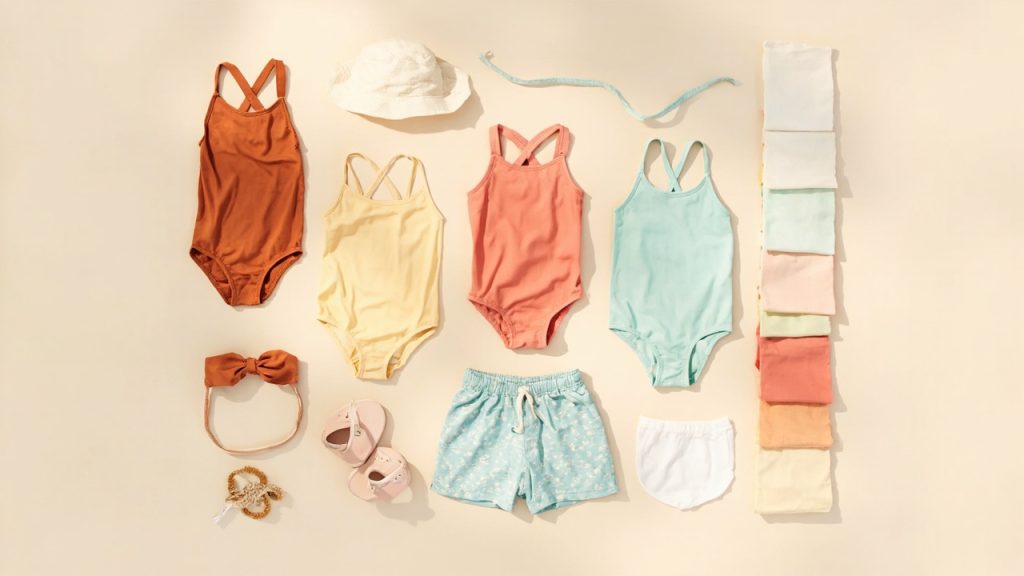
The dominant SS 2027 palette is a deliberate move away from the saturated digital brights that defined 2024 and 2025. Buyers are asking for earthy terracotta, soft butter yellow, faded coral, sun-faded aqua, and a warm off-white that is replacing stark optic white across most ranges. The accent story is gentler too: a single pop of saturated cobalt or hot magenta reserved for one or two pieces in a collection, rather than a full bright range. For kids’ swimwear specifically this matters because parents still associate neon with cheapness, and the SS 2027 palette reflects a deliberate move up-market. On the production side these tones are friendly to work with — the dyeing houses in our Fujian network already run most of these shades as stock colorways, which keeps MOQs reasonable and lead times short. For buyers wanting a fully bespoke palette, we recommend finalizing Pantone references no later than mid-October to keep the SS 2027 production window on schedule.
Fabric is the loudest trend conversation of the SS 2027 cycle. Across the briefs we have seen this season, three claims are now considered table stakes rather than premium upgrades: GRS-certified recycled polyester for the main body fabric, OEKO-TEX Standard 100 Class I certification for anything that touches a baby’s skin, and a UPF 50+ rating verified to the AS/NZS 4399 or equivalent standard for sun-protective claims. ECONYL regenerated nylon is also starting to appear in briefs from European brands with explicit ocean-plastic commitments, though pricing and minimum order quantities are still a step above conventional nylon. None of these are new fabrics, but the SS 2027 cycle is the first where they are being requested across nearly every brief rather than only by the most sustainability-forward labels. For our facility, the implication is meaningful: most of these certifications are already in place across our kid-focused fabric library, and we have begun rolling out GRS-certified recycled polyester lines for buyers who want a one-mill sourcing path for both fabric certification and finished garment production. We are also seeing more buyers ask for chlorine-resistant fabric treatments for rash guards and swim trunks, which extends product life and supports the durability story that parents are increasingly vocal about.
On the silhouette side, three shapes are doing most of the work in the SS 2027 briefs we are sampling. The first is the modest one-piece, which is back in a serious way across the 6 to 14 age range after years of two-piece dominance in the kids’ market. Modest coverage here means higher necklines, slightly longer torso lines, and a return to the sportier cut lines that European buyers associate with technical swimwear rather than beach cover-ups. The second is the rash guard set — a long-sleeve rash guard paired with matching swim shorts or swim leggings, often in a coordinating print rather than a solid. This silhouette is being requested by every mid-market buyer we have talked to in 2026, and the SS 2027 cycle looks like the year rash guards graduate from a UV-protection accessory to a primary category in their own right. The third is the coordinated family story, where a single print or color appears across a women’s swimsuit, a men’s swim short, a girl’s one-piece, and a boy’s rash guard set — a request that more buyers are making because it directly supports resort retail and Instagram-led marketing. Across all three silhouettes the common thread is cleaner construction: flatlock seams, bonded hems where the design allows, and prints that are engineered rather than placed. Our pattern room has been re-grading the standard block set to make these cleaner constructions easier to hit at the SS 2027 production volumes.
Functional details continue to move from niche to mainstream for SS 2027. Front zips on one-piece suits — once associated almost exclusively with baby swim — are now being requested across the entire kids’ range because they make changing easier for parents and reduce the wear on necklines from pulling garments over young heads. Adjustable shoulder straps on one-pieces and bikini tops are appearing more often in tech packs, and we are now specifying them as standard on the girls’ range blocks we keep in our pattern library. Inside the garments, the small things matter: brushed linings at the chest and seat panels for chlorine-prone styles, gusset construction that has been engineered to avoid the chafing complaints that come back on lower-priced competitors, and branded elastic that holds its stretch after twenty-plus wash cycles. We are also seeing more briefs specify a chlorine-resistant finish as a default for rash guards and swim trunks, which is a small line-item cost in production but a meaningful claim at retail.
Kids’ sizing in the SS 2027 cycle is trending more standardized than it has been in previous seasons. Most buyers we work with are now specifying the 92cm to 158cm height range, with the understanding that regional markets size slightly differently inside that range. We are keeping our kids’ swimwear block set graded in 6cm increments to match the most common brief, and our fit samples are built on standard dress-form sizes that map cleanly to those height points. The other sizing conversation is around vanity sizing — buyers are explicitly moving away from it for SS 2027 and asking for tech-pack measurements that match the actual garment rather than an aspirational size label. This is good news for production because it reduces the number of grading revisions per style and keeps the fit approval process on a tighter calendar. For buyers with their own sizing standards, we run a short fitting on our standard blocks before sampling so that grading time is spent on the brand-specific fit, not on rebuilding a standard block.
SS 2027 production timing is the topic on every brief that crosses our merchandising manager’s desk this month. Most buyers we work with are planning to lock their SS 2027 color and silhouette stories by the end of October, with first samples in hand by mid-December and bulk production running from January through March 2027 for retail delivery in February through May of next year. Sample lead times for the requests we have already received are running around 18 to 25 days from tech-pack confirmation, depending on fabric sourcing and print development; bulk production lead times are landing in the 50 to 70 day range after fabric is in-house, which is consistent with prior seasons. The big change for SS 2027 is that buyers are asking for earlier fabric commitments, often locking GRS-certified recycled polyester and ECONYL stock by late September to secure slot allocation at the mill level. Our recommendation to any brand still finalizing its SS 2027 story is to firm fabric and color choices by mid-October at the latest — that gives enough calendar room for grading, sample making, fit approval, and bulk production to land retail-ready without compressing any single phase of the timeline.
This is the swimwear sourcing environment our partners are planning into for SS 2027, and it lines up well with the way Northern has been building its kids’ swimwear program over the past several seasons. Recycled polyester and OEKO-TEX Class I fabrics are already in our library, our chlorine-resistant finish is standard on rash guards and swim trunks, and our pattern room has the modest one-piece and rash guard set blocks re-graded for the cleaner constructions that the market is asking for. For brands that want to lock SS 2027 sampling slots now, or for buying teams that want to understand what a sourcing path through Northern looks like, we welcome a brief at any time. Send it through the Contact page and our merchandising manager will respond within one business day with a sample plan, indicative capacity windows across our hanging and cutting lines, and a fabric-and-finish matrix matched to the SS 2027 trend directions above.