Container Loaded: Quanzhou Northern Garment Completes Children’s Spring Outerwear Order for European Buyer
Container Loaded: Quanzhou Northern Garment Completes Children’s Spring Outerwear Order for European Buyer
A 40-foot high-cube container was loaded and sealed this week at Quanzhou Northern Garment’s production facility in Jinjiang, marking the completion of a children’s spring outerwear order for one of our European brand partners. The container departed the facility under buyer seal and is now in transit to the port of Xiamen for vessel loading, with an estimated time of arrival at the destination port in early June. The shipment covers approximately 6,500 pieces across lightweight jackets, hooded vests, and matching pants, packed into 380 master cartons and tailored to the buyer’s specific packaging and labeling requirements.
The order was confirmed in late January and moved through the standard Northern production cycle over the following weeks. Pattern development and graded sizing were completed in the first two weeks, covering six size points from 92cm through 158cm to match the buyer’s size chart for the European retail channel. Fabric and trim sourcing followed immediately, drawing from our established supplier network in Quanzhou and the wider Fujian textile hub. Main production for jackets and vests began in early March on the factory’s automated cutting lines, with sewing split across multiple lines to keep daily output stable and to maintain the AQL 2.5 standard our buyer specifies in the technical pack. Throughout the run, our inline QC team performed daily checks on stitching, seam strength, snap placement, and zipper function; the buyer was sent weekly progress reports with photos and small sample swatches so that any fit or color decision could be made without slowing the line. By the final week of production the daily output had settled into a steady cadence, with the sewing floor reporting consistently against the target rate and no major style deviations flagged during the final fitting review.
This shipment sits inside Northern’s broader production program for the European market, where we now run three to four container shipments per month for brands focused on children’s outerwear and lightweight lifestyle apparel. Across our 30,000 square meter facility in Jinjiang, more than 600 production staff work alongside eight automated hanging production lines and five automated cutting machines, supported by a sourcing network that stretches across the Fujian textile hub and into the wider Yangtze River Delta. Our buyer portfolio leans heavily on partners who prioritize traceability and compliance: we maintain active BSCI and SA8000 social audits, hold OEKO-TEX Standard 100 certification across the majority of our kid-focused fabric library, and have begun rolling out GRS-certified recycled polyester lines for buyers with explicit recycled-content targets. None of these credentials are bolt-ons — they shape how we plan production runs from the moment a buyer’s tech pack arrives, because the same fabric and trim decisions made in week one determine whether a container can clear destination customs six weeks later. For this particular shipment, the chosen shell fabric carried an OEKO-TEX Standard 100 class I certificate, which the buyer’s import team had specifically requested for the European retail channel.
Pre-shipment inspection took place over the final ten days before container loading. Our QC lead coordinated with two of the buyer’s nominated inspectors to walk through one hundred percent of the finished cartons, with random sample pulls against the AQL 2.5 sampling plan for both major and minor defects. The inspection covered not only garment construction but also packaging integrity: polybag sealing, fold alignment, master carton weight, and barcode readability were all verified against the buyer’s packaging manual. After a brief round of touch-up packing — including a small number of polybag re-seals and replacement of two cartons that had been dented during stacking — the inspector signed off on the full quantity. Final packing lists, carton-level weight tickets, and the buyer’s required carton summary sheet were prepared and cross-checked against the purchase order line items before any carton was sealed for export. A short photo report was compiled alongside the inspection record, capturing carton labels, polybag sealing, and a representative garment laid flat for the buyer’s reference archive.
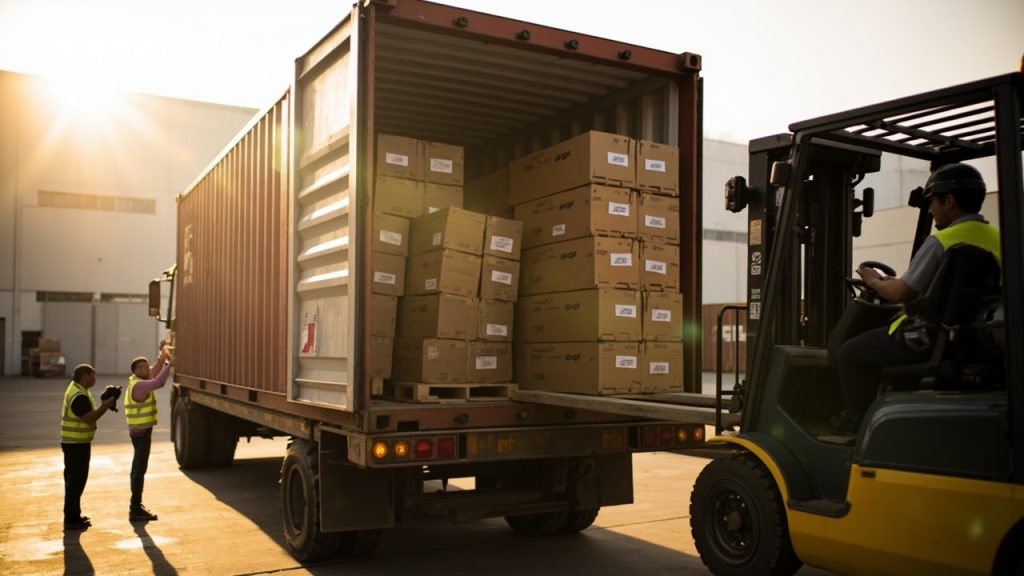
Container loading took place on the morning of the shipment date under clear skies. The 40HC container arrived from the shipping line’s depot the previous afternoon and was inspected by our logistics coordinator for any pre-existing damage, odor, or moisture before being positioned at the loading bay. Inside the warehouse, finished cartons had been staged in the order they would be loaded, with heavier pieces at the bottom and lighter cartons on top, and each layer braced with paper slip sheets to prevent shifting during transit. Our loading crew — three warehouse staff and one supervisor — worked with a forklift operator to build the load pallet by pallet across the morning, pausing briefly between layers to verify carton placement against the pre-planned load map. Once the container was filled, the doors were closed, the buyer’s numbered seal was applied under the supervisor’s direct watch, and a photograph of the sealed container with its seal number visible was sent to the buyer for their records.
The container is moving under FOB Xiamen terms, with the shipping line and vessel details confirmed by our logistics partner earlier in the week. The booking reference and the Bill of Lading draft have already been shared with the buyer’s import team, along with the commercial invoice, packing list, and certificate of origin issued through our local chamber of commerce. For each of our orders we also share the container number and seal number in advance so that the buyer can plan receiving at the destination port and pre-clear the shipment through their customs broker. The estimated time of arrival at the destination port is early June, depending on the vessel schedule and any port congestion along the way. Our logistics partner will continue to track the shipment and provide updated ETAs to the buyer as the vessel approaches the destination, with the aim of giving the receiving warehouse at least one full week of notice before arrival.
Communication with the buyer has run continuously from confirmation through loading. Beyond the standard weekly progress reports, we sent two updates during production that the buyer’s team specifically asked for: a fabric hand-feel video so that they could confirm the chosen material still met the original brief after sourcing, and a pre-shipment photo set showing the folded garments inside representative cartons so they could verify the folding standard before sealing. With the container now sealed, the buyer has received the loading photograph, the seal number, and a draft commercial invoice for their import team’s review. They have flagged that they would like a brief post-shipment follow-up once the container clears customs at the destination port, and our logistics partner is already set up to share that update directly with the buyer’s import coordinator on the day of clearance. The communication cadence we keep for this buyer reflects how we work with most of our longer-term partners. From PO confirmation onward, we send a structured weekly report covering the prior seven days — production output by line, inline QC pass rates against the AQL 2.5 sampling plan, any open issues that need buyer input, and a forecast for the next week. Reports are sent on Monday mornings local time so the buyer’s team in Europe has them before their working day starts. Outside of weekly reports, we send issue-specific updates the moment something materially changes: a fabric lead-time slip, a color lab dip result, a packaging deviation, a photo set from the floor. That cadence is what allowed this shipment to move from late-January PO confirmation to early-May container loading without any significant delay or rework, even as the European retail calendar compressed the buyer’s own receiving window.
This shipment reflects the production cadence Northern has built for European and North American buyers across kids’ outerwear, activewear, swimwear, and lifestyle apparel. With more than a decade of apparel manufacturing behind us, multiple automated cutting and hanging lines, and a sourcing network that reaches across the Fujian textile hub, we are set up to handle orders at the scale this buyer requires without losing the small-run attention to fit and finish that makes the difference on a children’s line. Above all, this shipment is a reminder that reliable export manufacturing is built on hundreds of small daily decisions, not a single big one. From the morning a tech pack lands on our merchandising manager’s desk to the moment a buyer’s seal is pressed onto a container door in our yard, every step is documented, photographed when it adds value, and traceable to a person. If you are a brand planning a children’s outerwear program for the next season, or a buying team looking to shift a portion of your current production to a more reliable manufacturing partner in mainland China, we welcome the opportunity to discuss your program. Send us a brief through the Contact page and we will respond within one business day with a tailored sourcing plan. For programs that need to start sampling in the next four to six weeks, we can also share indicative capacity windows across our hanging and cutting lines so that production timing can be planned before a final PO is signed.