EU Digital Product Passport for Textiles Hits Operational Phase for SS27 Buyers
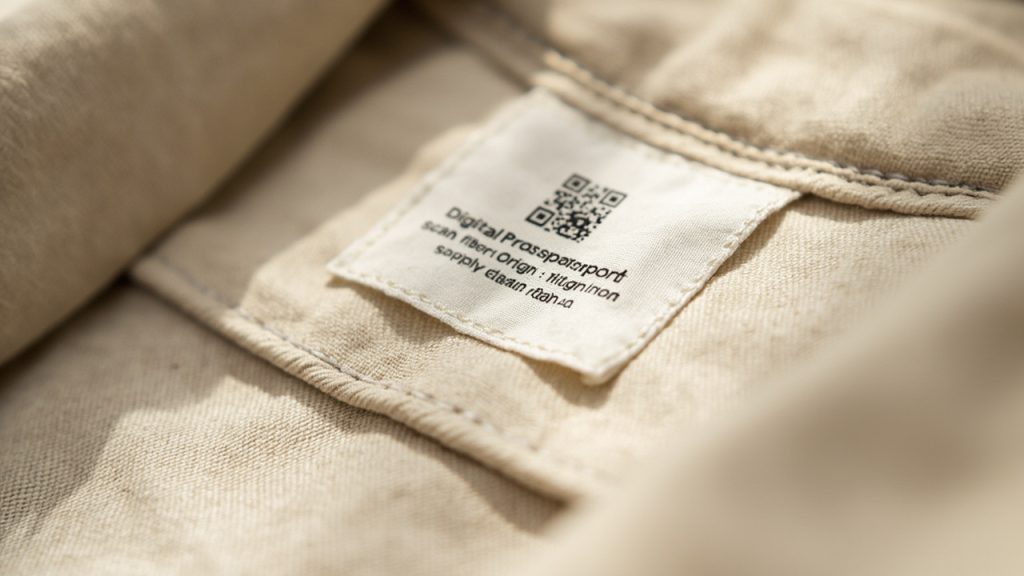
As of the first half of 2026, the European Union’s Ecodesign for Sustainable Products Regulation (ESPR) has moved from policy text to operational reality for textile and apparel products placed on the EU market. The textile Digital Product Passport (DPP) delegated act — adopted in late 2025 and now in force — is the first sectoral regulation that turns voluntary sustainability disclosure into a hard compliance requirement for every garment sold into the European Union.
According to reporting from Ecotextile News and Just-Style, the data points every DPP must capture at garment level include fibre composition with country of origin, manufacturing facility identifiers, chemical compliance status, durability and care information, repair pathway availability, and end-of-life recyclability classification. For OEM/ODM buyers, this is no longer a CSR checkbox — it is now upstream data that the factory must capture, retain, and make machine-readable through a registered DPP provider.
For buyers planning SS27 and AW27 collections into the European market, three concrete actions are now table stakes:
- Lock DPP-ready suppliers early. Buyers should confirm the factory’s DPP provider integration and the data fields they can populate before issuing the tech-pack, not after PO. The cost of retrofitting traceability records mid-season is materially higher than capturing them at sampling.
- Treat fibre origin documentation as a sourcing constraint. Country-of-fibre data, not just country-of-sew, is now part of the compliance perimeter. Buyers specifying organic cotton, recycled polyester, or specialty bast fibres should ask for chain-of-custody documents at the yarn level, not the finished-goods level.
- Build repair and end-of-life language into care labels now. The DPP framework rewards products that disclose repair pathway and recyclability classification. Buyers who integrate those disclosures into care-label design from SS27 onward will avoid costly last-minute artwork changes when enforcement tightens in 2027.
The broader lesson is that the DPP is, in practice, an extension of the audit conversation that the apparel industry has been having for a decade around social compliance — only now it lives in a standardised data layer that the European Commission, member-state authorities, and consumers can all read. Buyers who treat compliance as a data integration project with their factory partners will move faster than those who treat it as a marketing footnote.
Northern Garment supports buyers through this transition with DPP-ready documentation templates, a mill-direct fabric sourcing chain with retained yarn-level records, and a sampling team in Quanzhou that can integrate DPP data fields into the tech-pack from the first counter-sample onward. If your SS27 line is destined for the EU market, our sourcing desk is open for an early-stage data planning conversation.
Source: Ecotextile News, 2026-08-12